The Scottish Rite Explained: 4° to 32°, and the 33°
One body, a long sequence of degrees, and a double-headed eagle. What a reunion weekend is like, how the two US jurisdictions differ, and what the 33° actually is.
The Ancient and Accepted Scottish Rite is one organization, one membership, one set of dues, and a great deal of theater.
Where the York Rite is three bodies you join in sequence, the Scottish Rite is a single body that confers the 4th through the 32nd degrees. Its emblem is the double-headed eagle. Its members are Brothers, same as anywhere.
It is not Scottish, particularly. The Rite took its modern form in France and reached its full development in the United States, and the name is historical baggage rather than geography.
What the degrees actually are
The Craft degrees tell one continuous story. The Scottish Rite degrees do not: they are a sequence of distinct dramatic lessons, each with its own setting, cast, and moral. Ancient Israel, the Crusades, the Reformation, courtrooms, throne rooms. Themes run to duty, tolerance, justice, the abuse of authority, intellectual honesty, and the obligations of a man to his conscience against the pressure of institutions.
They are grouped into bodies (Lodge of Perfection, Chapter of Rose Croix, Council of Kadosh, Consistory in the Southern Jurisdiction, with a different arrangement in the Northern), but you join the Valley as a whole and the internal structure mostly matters to the officers.
You watch most of them. This is the single biggest experiential difference from the Blue Lodge. In the Craft degrees things happen to you. In the Scottish Rite, degree teams perform, in costume, on a stage, often with lighting and sets, and you are in the audience. Some Valleys confer a handful of degrees on the class in full and communicate the rest by summary.
Whether that appeals is a matter of taste, and it is worth knowing before you sign up rather than after.
The reunion
Most Valleys confer degrees at a reunion: a concentrated weekend, once or twice a year, where a class of candidates receives many degrees in two or three days.
It is efficient, it is genuinely impressive when the degree team is good, and it is a firehose. Nobody absorbs twenty-nine degrees in a weekend. The Rite knows this: the material is published, the reading is encouraged, and men re-attend reunions for years to see the degrees they missed the meaning of the first time.
The two US jurisdictions
The United States has two Supreme Councils, and they are genuinely different:
- Southern Jurisdiction (SJ): headquartered at the House of the Temple, Washington, DC. Covers most of the country, some 35 states.
- Northern Masonic Jurisdiction (NMJ): 15 northeastern states, including Pennsylvania.
They differ in some degree names, in how the work is presented, and in the details of their charitable programs. If you are in PA you are in the NMJ, and material written for the SJ, including a lot of what turns up in online searches, will not match what you see.
The 33°
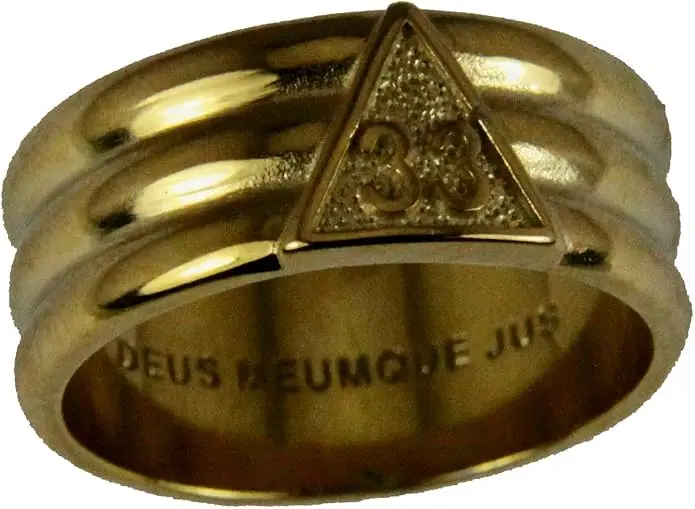
Honorary. Conferred by the Supreme Council on members chosen for distinguished service to the Rite or to Masonry generally.
You cannot petition for it. You cannot buy it. There is no attendance record or degree count that entitles you to it. Any product, website, or organization offering the 33° for money is selling something worthless, and every genuine Scottish Rite Mason will tell you the same.
The intermediate honor in the SJ is the Knight Commander of the Court of Honour (KCCH); the NMJ has its own recognitions. Both are likewise conferred, never requested.
Charity
The Rite’s philanthropy is substantial and worth knowing about because it is often the reason men stay. The NMJ’s flagship program is the Scottish Rite Children’s Learning Centers, providing free treatment for childhood language and learning disorders; the SJ runs RiteCare clinics on the same model. Neither charges the families it serves.
What it costs
One initiation fee, one annual dues line, typically comparable to a Blue Lodge’s, sometimes a little higher. There is no second and third body stacking on top the way there is in the York Rite, which is why the Scottish Rite is usually the cheaper of the two lanes.
Regalia is light. A 32° ring and a double-headed eagle lapel pin are the visible markers, and the Valley supplies caps or regalia where the local practice calls for them. There is no equivalent of the Commandery uniform expense.
Should you join it?
If you like reading, argument, history, and being made to think about ethics for their own sake, yes, and you will find your people quickly.
If you would rather be on the floor performing ritual than in a seat watching it, the York Rite will suit you better.
If you cannot decide: join both. Vast numbers of Masons do, and in most towns the two Rites meet in the same building.
Head to head: York Rite vs. Scottish Rite.
The standing caveat
Degree names, groupings, and presentation differ between the SJ, the NMJ, and Supreme Councils outside the US. Everything above describes the American pattern in general terms; your Valley’s Secretary is the authority for your Valley.
![Square & Compass Masonic Lapel Pin - [Blue & Gold][1'' Tall] — product photo](/images/products/square-compass-masonic-lapel-pin-blue-gold-1.webp)
![Square & Compass Round Masonic Lapel Pin - [Antique Brass Finish][1''… — product photo](/images/products/square-compass-round-masonic-lapel-pin-antique-brass.webp)
![Square & Compass Masonic Leather Journal - [Brown] — product photo](/images/products/square-compass-masonic-leather-journal-brown.webp)
![Square & Compass Black Leather Medallion Masonic Key Chain - [Blue & Gold][3… — product photo](/images/products/square-compass-black-leather-medallion-masonic-key-chain.webp)